Why readers search for a Kerassentials review
Most people looking up a Kerassentials review are not starting with a blank page. They have usually seen strong language somewhere else first: phrases about clearing nail fungus, restoring stronger nails, or improving surrounding skin quickly. That creates a familiar problem in this niche. Searchers are pushed toward a yes-or-no decision before they have had a chance to check the simple basics: what kind of product it is, how it is used, what ingredients are actually listed, and whether the public policy information feels consistent.
That is also why a review page should not behave like a second sales page. What matters most here is orientation. In the public-facing material, Kerassentials is presented as a daily topical oil, not as a prescription treatment and not as an ingestible supplement. For a reader comparing products in the nail-care category, that distinction matters because the expectations, the usage routine, and the kind of claims being made are all different from what you would expect from a pill or a medical treatment.
What the product appears to be
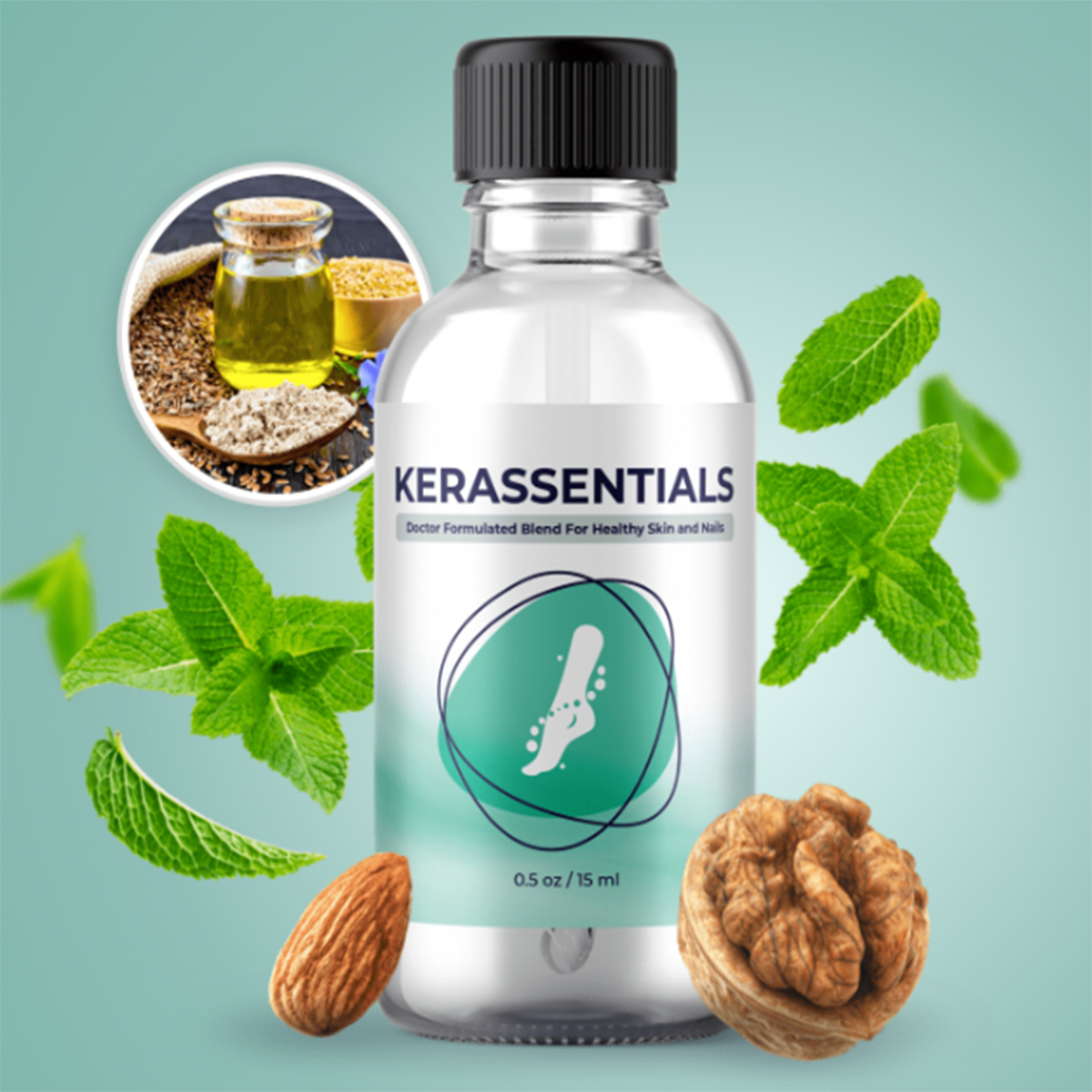
Across public sales pages, Kerassentials is framed as a doctor-formulated nail and skin oil meant to be brushed directly onto nails and nearby skin. The public copy repeatedly positions it around cosmetic and routine-care concerns such as brittle nails, yellowing, cracked skin around cuticles, and surface-level fungal-looking problems. The product is generally shown as a small bottle with a brush applicator, which makes the topical format one of the clearest points in the public materials.
Another consistent theme is that the formula is presented as plant-based or essential-oil-led rather than chemical-heavy. That does not prove performance on its own, but it does help explain the product’s market position. Kerassentials is being sold as a convenience product for regular surface use: a brush-on oil meant to fit into a simple nail-care routine, not a detailed medical program.
What can be verified directly
- Public pages repeatedly present Kerassentials as a topical oil applied to nails and surrounding skin.
- A brush applicator is shown on public product pages, which supports the brush-on format being part of the offer.
- The publicly repeated ingredient theme includes tea tree oil, lavender oil, clove bud oil, almond oil, aloe vera, flaxseed oil, lemongrass oil, vitamin E, and undecylenic acid.
- At least one public-facing page describes a 15 mL bottle as about one month of supply.
- A 60-day money-back guarantee is repeated across public sales pages.
- Public pages also reference checkout through ClickBank and list a contact email for support questions.
Kerassentials ingredients and formula notes
The ingredient side of the Kerassentials review is one of the easier areas to summarize because the public pages tend to repeat the same cluster of oils and supporting compounds. Tea tree oil, lavender oil, clove bud oil, almond oil, flaxseed oil, aloe vera, lemongrass oil, vitamin E, and undecylenic acid appear regularly in the public-facing copy. For searchers using terms such as Kerassentials ingredients or Kerassentials formula, that repeated list is a useful starting point.
What matters, though, is how those ingredients are being used in the copy. The marketing language often jumps from “these ingredients are present” to “the product solves the full problem.” A more careful reading is simpler. Publicly, the formula is being described as an oil blend aimed at surface care, moisture support, and a cleaner-looking nail environment. That is a reasonable description of the product presentation. It is not the same as independently proving every broader claim attached to it.
There is also a practical point worth noting. Different public pages do not always describe usage in the same way. One version emphasizes application after showering, another frames use as twice daily, and another gives a more aggressive multi-drop routine. That kind of inconsistency does not automatically make the product illegitimate, but it does mean readers should pay close attention to the label and checkout materials they actually receive.
What seems clear vs. what still needs checking
What seems clear
- Kerassentials is being sold publicly as a topical nail-care oil.
- The product presentation leans heavily on essential oils and surface-care language.
- The public offer consistently highlights a 60-day refund window.
- The nail-care positioning is broad enough to cover both nails and nearby skin.
What still needs checking
- Which public domain should be treated as the main official page, because multiple lookalike domains appear in search.
- The definitive application routine, since public pages do not phrase the directions the same way.
- How the refund process is handled in practice once an order is placed.
- Whether the ingredient list and support details match exactly across all current sales pages.
For readers searching terms such as Kerassentials legit, Kerassentials complaints, or Kerassentials side effects, this middle ground matters. The public materials are strong on promotional confidence, but the cleaner review question is whether the visible details remain consistent and easy to verify from page to page.
Policy, support, and public-information notes
Policy details are not the dominant focus of this review, but they still matter because they help separate a polished product page from a practical one. Public-facing materials repeatedly mention a 60-day money-back guarantee, and at least one public page lists a support email for questions. Public checkout language also points readers toward ClickBank processing. Those are meaningful signals because they tell you where a purchase path is supposed to run and where support questions are meant to go.
At the same time, this is an area where readers should stay concrete. A refund headline is useful, but the exact steps, timing expectations, and any edge conditions are the details that actually matter if a buyer later needs help. That is why it makes sense to treat the guarantee as a visible public claim first, then verify the current terms again on the order path rather than assuming every third-party page is perfectly synchronized.
Short FAQ for Kerassentials review searches
Is Kerassentials a pill or a topical product?
Public materials present it as a topical oil with a brush applicator, used on nails and nearby skin rather than swallowed as a capsule.
Which ingredients are mentioned most often?
The recurring list on public pages includes tea tree oil, lavender oil, clove bud oil, almond oil, aloe vera, flaxseed oil, lemongrass oil, vitamin E, and undecylenic acid.
Does a Kerassentials review prove the product works?
No. A review like this is mainly useful for separating the visible product presentation from bigger marketing promises. It can clarify what is publicly listed, but it is not the same thing as proving outcome claims.
What should a careful reader verify before ordering?
The most practical checks are the exact official page, the current directions for use, the current ingredient list, and the refund instructions shown at checkout.
Bottom line
As a public-facing product, Kerassentials is fairly easy to understand at a high level: it is marketed as a brush-on oil for nails and surrounding skin, built around an essential-oil formula and sold with a refund promise. What makes the review angle useful is not a dramatic verdict. It is the chance to notice that the public copy is more consistent on the broad pitch than on the fine details. For many readers, that is the right takeaway: the product category and ingredient theme are clear, but the exact directions, domain, and purchase-path details deserve one more careful look before treating any single page as definitive.
If that is the stage you are at, the next useful step is not another hype-heavy review. It is the fuller product guide, where the purchase path and policy information can be checked in one place with less noise.
← Back to Nail Care